Logo of Ing. Erhard Fischer GmbH
  • Home
  • Products
    • INDUSTRIAL POWER SUPPLIES
      • AC loads
      • AC grid simulators
      • AC sources
      • DC/DC converter
      • DC loads
      • Bidirectional DC power supplies
      • DC sources
      • Inrush current limiter
      • Industrial power suppy units
      • Measuring devices
      • Switch cabinet construction
      • OEM - Customized power supply units
    • MEASUREMENT TECHNOLOGY
      • display devices
      • Ground fault and short circuit indicator
      • ground fault indicator
      • overhead line indicator
      • cable junction boxes
      • short-circuit indicator
      • Electrical Measuring Instruments
      • Process Controller
      • Sensors for earth faults
      • Sensors for short circuits
      • Voltage tap terminals
      • Voltage display and detection
      • temperature sensor
      • converter
    • FUEL CELLS
      • Methanol Fuel Cells
      • Hydrogen Fuel Cells
    • THERMAL SOLUTIONS
      • Flexible heaters
      • Cartridge heaters
      • Customer-specific heaters
      • Customized heater assemblies
      • Peltier elements
  • Applications
    • Industrial power supplies
      • Charging drive systems
      • AC network simulations
      • Fuel cell tests
    • Thermal Solutions
      • Imaging and Optical Systems
      • Spacecraft and Satellite Battery Systems
      • IR detectors and EO/IR systems
      • Ventilators & respirators
      • PCR-DNA thermocycling
      • Valves and dosing pumps
      • Liquid heating
      • Respiratory function analysis
      • Heating of samples
    • Measurement technology
  • Services
  • References
  • About Us
    • NEWS
  • Home
  • Products
    • INDUSTRIAL POWER SUPPLIES
      • AC loads
      • AC grid simulators
      • AC sources
      • DC/DC converter
      • DC loads
      • Bidirectional DC power supplies
      • DC sources
      • Inrush current limiter
      • Industrial power suppy units
      • Measuring devices
      • Switch cabinet construction
      • OEM - Customized power supply units
    • MEASUREMENT TECHNOLOGY
      • display devices
      • Ground fault and short circuit indicator
      • ground fault indicator
      • overhead line indicator
      • cable junction boxes
      • short-circuit indicator
      • Electrical Measuring Instruments
      • Process Controller
      • Sensors for earth faults
      • Sensors for short circuits
      • Voltage tap terminals
      • Voltage display and detection
      • temperature sensor
      • converter
    • FUEL CELLS
      • Methanol Fuel Cells
      • Hydrogen Fuel Cells
    • THERMAL SOLUTIONS
      • Flexible heaters
      • Cartridge heaters
      • Customer-specific heaters
      • Customized heater assemblies
      • Peltier elements
  • Applications
    • Industrial power supplies
      • Charging drive systems
      • AC network simulations
      • Fuel cell tests
    • Thermal Solutions
      • Imaging and Optical Systems
      • Spacecraft and Satellite Battery Systems
      • IR detectors and EO/IR systems
      • Ventilators & respirators
      • PCR-DNA thermocycling
      • Valves and dosing pumps
      • Liquid heating
      • Respiratory function analysis
      • Heating of samples
    • Measurement technology
  • Services
  • References
  • About Us
    • NEWS
Inquiry
Fuel Cells/ Hydrogen Fuel Cells

Hydrogen Fuel Cells

For self-sufficient and hybrid energy systems

Hydrogen Fuel Cells for a Reliable Energy Supply

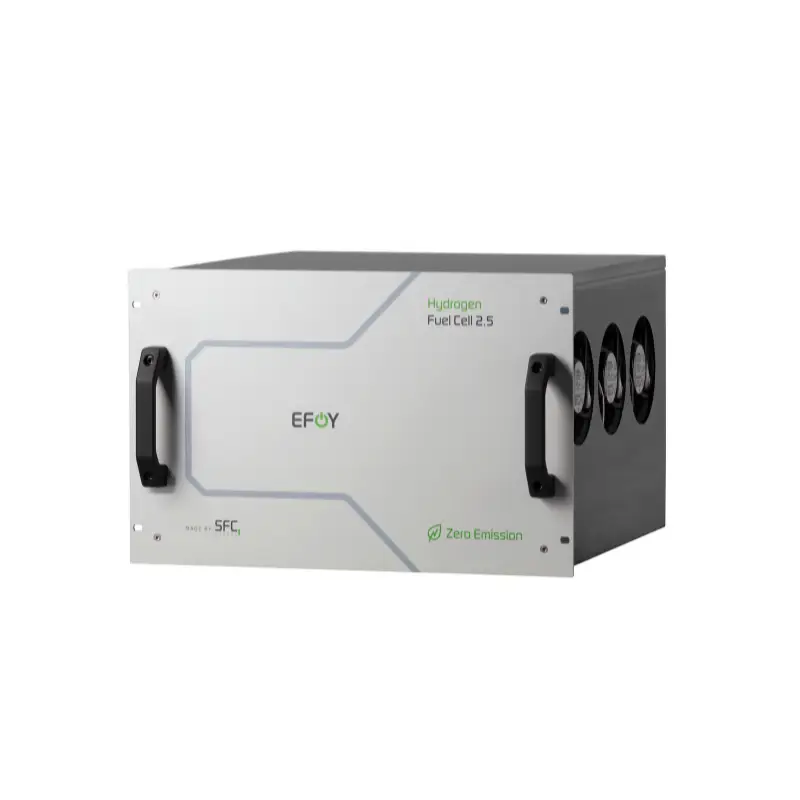
When a reliable power grid is not available or an existing power supply needs to be secured in the event of a power outage, hydrogen fuel cells can be part of a self-sufficient or hybrid power supply solution. Typical applications range from critical infrastructure and cellular communications to mobile and stationary power supply systems.

However, whether a hydrogen fuel cell is the right solution cannot be determined based solely on the required power output. Power and energy requirements, operating time, load profile, existing battery or UPS systems, hydrogen supply, and operating conditions must all be considered together.

Ing. Fischer GmbH helps you develop a suitable energy supply concept based on these requirements and integrate the fuel cell into the overall system.

 REQUEST PRODUCT

What is a hydrogen fuel cell?

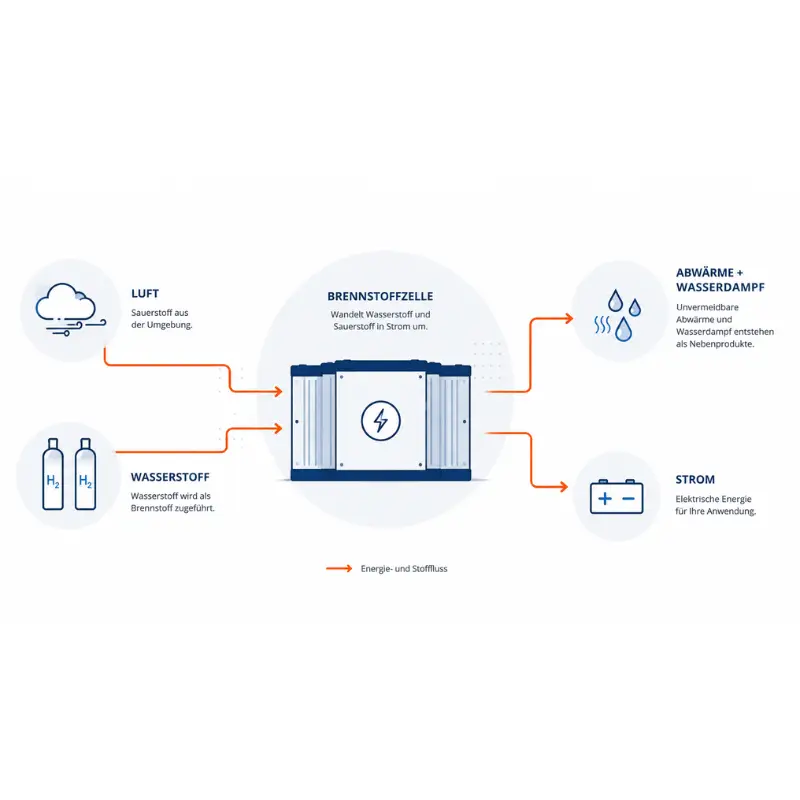
A hydrogen fuel cell converts the chemical energy stored in hydrogen into electrical energy. Hydrogen is fed into the fuel cell as an energy source, while the oxygen required for the reaction is drawn from the ambient air. The electrochemical reaction produces electrical energy, waste heat, and water vapor.

Unlike a diesel generator, electricity is generated without a traditional combustion process. Therefore, the operation of the fuel cell does not produce any local CO₂ or pollutant emissions.

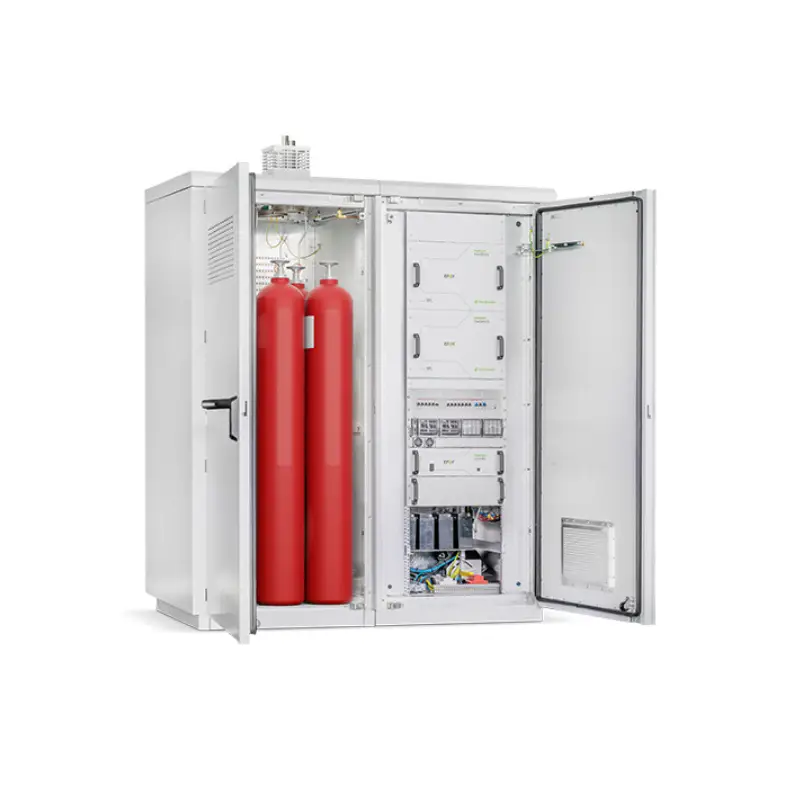
From a technical standpoint, it is particularly important that the fuel cell be viewed as part of an energy supply system. For example, it can be combined with a battery, a UPS, and other energy sources. Depending on the system architecture, the individual components perform different tasks.

.

Frequently Asked Questions & Answers:

  • Hydrogen fuel cells are a particularly viable solution when a technical facility needs a reliable supply of electrical energy and grid power is either unavailable or not sufficiently reliable.

    This technology is an option when:

    • a longer runtime or backup time is required,
    • a purely battery-powered system would require a correspondingly large battery capacity,
    • higher electrical power is required,
    • a mobile or decentralized power supply is required,
    • existing battery or UPS systems are to be supplemented with an additional power source,
    • quiet operation and the avoidance of local CO₂ and pollutant emissions are important factors when compared to a diesel generator, or
    • Critical infrastructure must continue to be supplied even during a prolonged power outage.


    Whether hydrogen is technically and economically suitable for this purpose depends, in particular, on power and energy requirements, the required operating time, hydrogen supply, installation conditions, and integration into the overall system.

  • Hydrogen fuel cells can be used in both stationary and mobile power supply systems. They are particularly relevant for applications in which security of supply, extended operating times, or higher power requirements play an important role.

    Critical Infrastructure

    In the event of a failure in the regular power supply, certain technical systems must remain operational. Hydrogen fuel cells can be part of a backup or emergency power supply in such cases. The required system architecture depends, among other things, on the power output needed, the backup time, and the available UPS or battery systems.

    Mobile Communications and Telecommunications

    Mobile phone and communications systems require a reliable power supply even during a power outage. Hydrogen fuel cells can supplement existing battery or UPS systems and extend the potential backup time.

    Data Centers and Technical Infrastructure

    For applications with high availability requirements, hydrogen can be evaluated as an additional energy source for backup and alternative power solutions. Key factors to consider include power requirements, required availability, hydrogen supply, and integration into the existing infrastructure.

    Mobile and Temporary Power Supply

    Electricity is also needed at construction sites, at events, or for mobile systems, even when there is no suitable grid connection available. Hydrogen fuel cell systems offer an alternative to conventional generator solutions in these situations.

    Emergency Services, Security, and Defense

    Mobile communication, security, and utility systems may also require an off-grid power supply. The appropriate solution depends on power requirements, operating duration, mobility, hydrogen supply, and environmental conditions.

  • The advantages of a hydrogen fuel cell must always be evaluated in the context of the specific application and the overall energy supply system.

    Longer range without relying solely on larger battery packs

    For longer backup periods, a battery-only solution may require correspondingly large battery storage systems. An alternative system architecture involves combining a battery or UPS with a fuel cell.

    For example, the battery provides short-term backup power, while the fuel cell subsequently supplies additional energy. As a result, the potential operating time is largely determined by the amount of fuel available.

    No local CO₂ or pollutant emissions during operation

    In a hydrogen-powered fuel cell, the electrochemical reaction produces water and heat. This makes hydrogen fuel cells particularly suitable for applications where local emissions need to be avoided.

    Hydrogen can be produced in an environmentally friendly manner through electrolysis using renewable electricity, such as wind or solar power. The hydrogen produced through this process is therefore carbon-neutral.

    Quiet operation

    Unlike a conventional internal combustion engine, electricity is generated electrochemically. Hydrogen fuel cell systems may therefore be of interest for applications where noise levels are an important selection criterion. The specific noise levels depend on the overall system in question.

    Scalability for Different Performance Requirements

    Hydrogen fuel cell systems are available in various power classes. Depending on the specific system, multiple units can be combined or arranged in a modular configuration. This allows the system architecture to be adapted to different power requirements.

  • Hydrogen and methanol fuel cells should not be categorically classified as “better” or “worse.” Both technologies can be used for off-grid or backup power supply, but they differ in terms of power range and fuel supply, among other factors.

    In making this selection, the following questions in particular should be considered:

    • Power: What continuous and peak power ratings are required?
    • Autonomy: How long must the system operate without a grid connection?
    • Load Profile: Is energy demand constant, or does it fluctuate significantly?
    • Fuel Supply: Which energy source makes sense to procure and store at the site?
    • Existing Infrastructure: Are batteries, a UPS, or a photovoltaic system already in place?
    • Installation Site: What are the spatial and environmental requirements?
    • Integration: What electrical and communication interfaces are required?
    • Monitoring: Does the system need to be monitored remotely?
    • Operations & Service: What are the requirements for maintenance and on-site service calls?


    Hydrogen solutions can be particularly attractive when higher electrical power is required and a suitable hydrogen supply can be established. Methanol, on the other hand, can be particularly attractive for lower power requirements as well as for mobile and decentralized applications.

    We evaluate which technology is suitable for a specific project based on the overall energy supply requirements. You will receive a solution tailored specifically to your project.

  • Selecting a hydrogen fuel cell based solely on its rated power is insufficient.

    When designing the system, power and energy must be considered separately: How much electrical power does the application require at a given moment—and how much energy must be available over the entire desired operating period?

    At the start of a design process, therefore, at least the following questions should be answered:

    1. What is the continuous power requirement for the application?
      The starting point is the connected loads and their actual power consumption.
    2. Are there peak loads?
      Consumers may occasionally require significantly more power than during normal operation.
    3. What level of autonomy or backup time is required?
      Should the system operate for hours, several days, or a longer period without grid power?
    4. What type of battery or UPS is available?
      The battery type, capacity, system voltage, and existing battery or UPS management system all influence the system architecture.
    5. How is the hydrogen supplied?
      The required amount of hydrogen and its supply must be considered in conjunction with the power demand and the desired operating time.
    6. Under what conditions is the system operated?
      The installation location, temperature, and other environmental conditions can influence the selection of suitable components.
    7. How should the system be monitored?
      For hard-to-reach or critical systems, operating conditions, alarm messages, and remote monitoring may already be factors to consider during the system selection process.

    .
    Based on this information, it is possible to determine the role the fuel cell is intended to play in the overall system, as well as the power class, fuel supply, and system architecture required for that role.

  • Many projects already have an existing power supply. Batteries, UPS systems, electrical distribution systems, control systems, and other components should not be replaced, but rather supplemented with an additional power source. The key question is therefore:

    How should the hydrogen fuel cell interact with the existing energy supply?

    Factors such as system voltage, power requirements, battery management, power-on and power-off conditions, and electrical and communication interfaces must be taken into account. In addition, the hydrogen supply must be incorporated into the overall concept.

    We therefore consider not only the individual fuel cell, but the entire system architecture. The goal is to coordinate the components in such a way that the required energy supply for the specific application is achieved.

Consulting, Design, and Integration by Ing. Fischer GmbH

When choosing a hydrogen fuel cell, it's not just a matter of finding a unit with the right rated power.

Ing. Fischer GmbH can help you determine which power supply solution makes the most technical sense for your application. Depending on the project, we consider factors such as:

() Power and energy requirements,
() Desired runtime,
() Existing battery and UPS systems,
() Suitable fuel cell technology,
() Hydrogen supply and required fuel quantity,
() Installation and environmental conditions,
() Electrical and communication interfaces,
() Monitoring requirements and
() Integration into the existing system.

Based on this, we select the appropriate components for your project and integrate them into a system tailored to your application. The key factors here are your specific requirements, the technical conditions, and how the individual components interact.

Get in touch with us
Back to: Fuel Cells
YOUR INQUIRY

What are your requirements?

Whether standard product or customer-specific requirement. We look forward to supporting you competently in finding a solution with in-depth customer advice.

You will only find high-quality products with us. Some standard appliances are available from stock at short notice.

We look forward to your inquiry.

    Here you can attach a file to your message:


    About us

    Founded in 1982, Ing. Erhard Fischer GmbH has been a premium solution provider for customers in the manufacturing industry, research & development, automotive, solar, automation technology, aerospace, university research, medical technology, utilities, etc. for over 40 years. In addition to standard products, we also offer highly complex special solutions and complete systems.

    Contact us

    • AT-2371 Hinterbrühl,
      Weissenbach 101
    • office@ing-fischer.at
    • +43 (0)2236 42694-0

    Navigation

    • Ing. Erhard Fischer GmbH
    • Industrial power supplies
    • Thermal Solutions
    • Measurement technology
    • Services
    • References
    • About Us
    • Inquiry
    • Ing. Erhard Fischer GmbH
    • Industrial power supplies
    • Thermal Solutions
    • Measurement technology
    • Services
    • References
    • About Us
    • Inquiry
    © 2026 Ing. Erhard Fischer GmbH
    • Imprint
    • General Terms and Conditions
    • Privacy Policy
    • Imprint
    • General Terms and Conditions
    • Privacy Policy
    Give us a call Send an e-mail Subscribe to newsletter