
When a reliable power grid is not available or an existing power supply needs to be secured for an extended period, methanol fuel cells can be part of a self-sufficient or hybrid power supply solution. Typical applications range from mobile measurement and security systems to radio and communications equipment.
However, whether a methanol fuel cell is the right solution is not determined solely by the required power output. Operating time, load profile, existing battery or UPS systems, additional energy sources, fuel supply, and operating conditions must all be considered together.Ing. Fischer GmbH helps you develop a suitable power supply concept based on these requirements and integrate the fuel cell into the overall system .
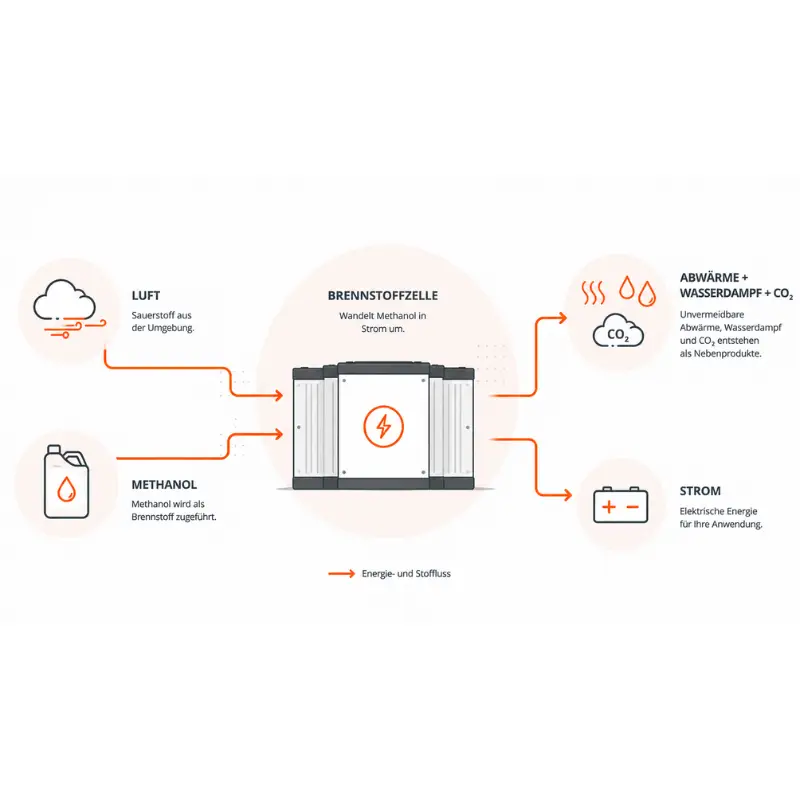

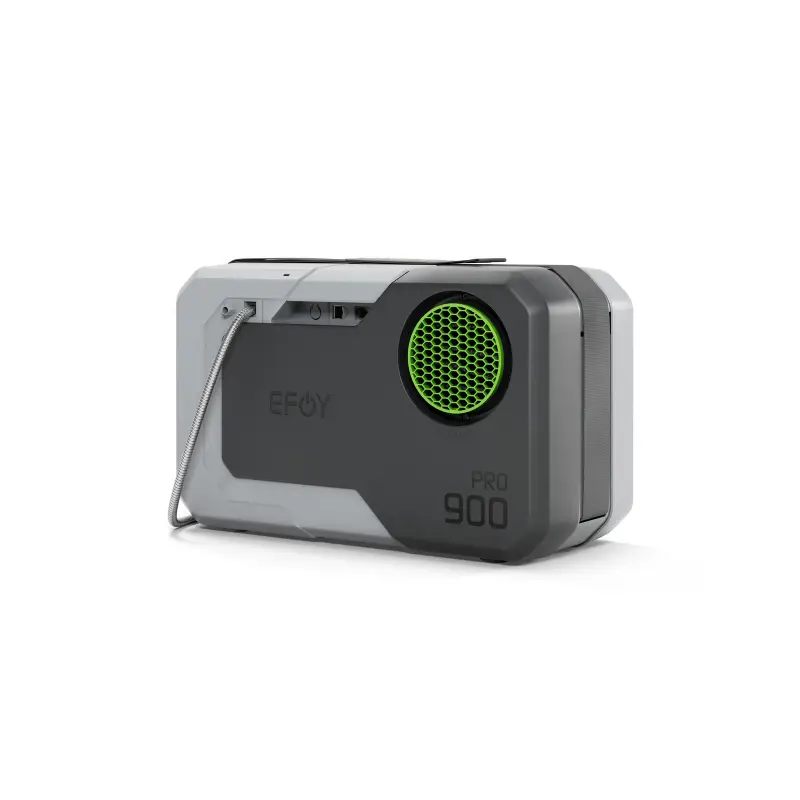

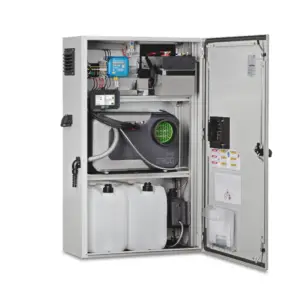
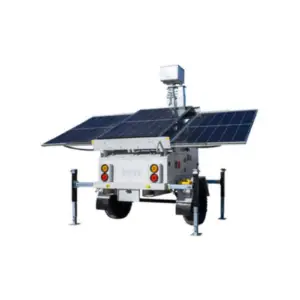
A methanol fuel cell uses methanol as an energy source to generate electrical energy. Depending on the fuel cell technology, methanol can be converted electrochemically directly or first converted into a hydrogen-rich gas. In a direct methanol fuel cell —or DMFC (Direct Methanol Fuel Cell)—methanol is converted electrochemically directly within the fuel cell. Unlike a diesel generator, electricity is generated without a traditional combustion process. The electrochemical reaction produces not only electrical energy but also heat, water, and CO₂.
From a technical standpoint, it is particularly important to recognize that a fuel cell should not be viewed in isolation. For example, it can be combined with a battery and other energy sources, such as photovoltaics, to form a hybrid energy supply system.
This allows the battery to handle short-term loads, while the fuel cell is used to maintain the power supply over a longer period of time.
.
Methanol fuel cells are particularly worth considering as a potential solution when a piece of equipment needs a reliable supply of electrical power over an extended period and a grid connection is either unavailable or not sufficiently reliable.
This technology is an option if:
However, this does not mean that methanol is automatically the best solution for each of these requirements. Performance, energy requirements, fuel logistics, installation conditions, integration, and operation must be evaluated for the specific application.
Methanol fuel cells may be of particular interest for mobile and decentralized applications, as well as for securing technical infrastructure.
Radio and Communication Systems
In some cases, radio and communications systems must continue to operate even when the regular power supply fails. A fuel cell can supplement an existing battery or UPS solution and extend the available backup time.
Measurement and Monitoring Systems
Monitoring stations for environmental, traffic, or other technical data are often located in remote areas. When it comes to power supply, therefore, in addition to electrical power, factors such as operational autonomy, available energy sources, and the accessibility of the location are particularly relevant.
Mobile Security and Surveillance Systems
Mobile cameras, surveillance, and security systems require power even in locations where a permanent power connection is not available. Methanol fuel cells can be an integral part of a mobile power supply system.
Emergency Services and Response Agencies
An off-grid power supply may also be necessary for emergency response organizations’ mobile radio, communications, and utility systems. The appropriate system architecture depends on power requirements, mobility, duration of operation, and environmental conditions.
Construction sites and temporary infrastructure
A suitable power supply is not always available at temporary sites. Fuel cells can be tested in these situations, particularly when electrical loads need to be powered for extended periods of time.
The advantages of a methanol fuel cell cannot be meaningfully assessed in isolation from its application. Rather, the decisive factor is the role the fuel cell plays within the overall energy system.
Longer range without relying solely on larger battery packs
If a system is to operate without a power supply for an extended period of time, the necessary energy must be provided.
One option is to design the battery with sufficient capacity. Another system architecture could involve combining a battery with a fuel cell. The fuel cell would then provide additional energy from the fuel carried on board.
Which of these solutions makes more sense from a technical and economic standpoint depends on the load profile and the required runtime.
Combination of a Battery and Photovoltaics
Methanol fuel cells can be part of hybrid energy supply systems.
One possible concept consists of:photovoltaic system → battery → load + fuel cell as an additional energy source
When solar output is sufficient, the photovoltaic system generates energy and charges the battery. If the available energy is no longer sufficient, the fuel cell can provide additional energy—depending on the specific system architecture.
This allows the energy supply to be optimized not based on a single component, but rather on the interaction of multiple energy sources.
Liquid fuel
Methanol is a liquid under normal ambient conditions. This is relevant when designing a self-sufficient system because it is necessary to consider not only the electrical output but also the provision and storage of the required energy at the site of operation.
The specific methods used to store, supply, and replace the fuel depend on the particular fuel cell system and the applicable requirements.
Quiet operation
Since the electrical energy is generated electrochemically rather than by a conventional internal combustion engine, methanol fuel cells may be particularly suitable for applications in which noise levels are an important selection criterion. The specific noise levels depend on the product and must be tested based on the respective system.
Methanol and hydrogen fuel cells should not be categorically classified as “better” or “worse.”
Which technology is suitable for a given application depends on several technical and operational factors. To make an informed decision, the following criteria and questions, among others, must be considered.
Your contact at Ing. Fischer GmbH will evaluate the various technologies based on your requirements, and we will provide you with the solution best suited to your project.
Selecting a fuel cell based solely on its rated power is not sufficient.
When designing the system, power and energy must be considered separately: How much electrical power does the application require at a given moment—and how much energy must be available over the entire desired operating period?
At the start of a design process, therefore, at least the following questions should be answered:
The starting point is the connected loads and their actual power consumption.
Motors, communication systems, or other loads may occasionally require more power than during normal operation.
Is the system supposed to operate for hours, several days, or a longer period without power from the grid?
Battery type, capacity, system voltage, and existing battery or UPS management systems influence the system architecture.
Solar power or other energy sources can meet a portion of the energy demand and must be taken into account during the sizing process.
The installation location, temperature, and other environmental conditions can influence the selection of suitable components.
For hard-to-reach or critical systems, operating conditions, alarm messages, and remote monitoring may already be relevant during the system selection process.
Based on this information, it is then possible to determine what role a fuel cell should play in the overall system and what power class and fuel storage capacity are required for that purpose.
In many projects, planning doesn’t start from scratch. Often, a battery, UPS, photovoltaic system, or existing control system is already in place and needs to be supplemented with an additional energy source. In that case, the key question is:
"How should the fuel cell interact with the existing energy supply?"
Factors such as system voltage, battery management, state of charge, power-on and power-off conditions, available energy sources, and electrical and communication interfaces must be taken into account.
Ing. Erhard Fischer GmbH Therefore, it views the fuel cell as part of a system architecture. The goal is to coordinate the components in such a way that the required energy supply for the specific application is achieved.
A backup power system featuring a methanol fuel cell was designed for an energy utility. The goal was to ensure the power supply to a radio system for a period of 14 days, even in the event of a failure in the regular power supply.
The facility was completed within a year and officially commissioned and unveiled in August 2024.
The project demonstrates how methanol fuel cells can be used in applications that require a long backup time and a reliable energy supply for technical infrastructure.
When selecting a methanol fuel cell, it's not just a matter of finding a unit with the right rated power.
Ing. Fischer GmbH can help you determine which power supply solution makes the most technical sense for your specific application. Depending on the project, we consider factors such as:
() Power and energy requirements,
() Desired runtime,
() Existing battery and UPS systems,
() Photovoltaics and other energy sources,
() Suitable fuel cell technology,
() Fuel storage,
() Electrical and communication interfaces,
() Monitoring requirements and
() Integration into the existing system.
Based on this, we select the appropriate components for your project and integrate them into a system tailored to your application . The key factors here are your specific requirements, the technical conditions, and how the individual components interact.
Do you know which facility needs to be powered—but aren't sure yet which fuel cell or system architecture is right for it?
Together, we'll determine which fuel cell solution is right for your application and how it can be optimally integrated into the overall system.
We look forward to your inquiry.